
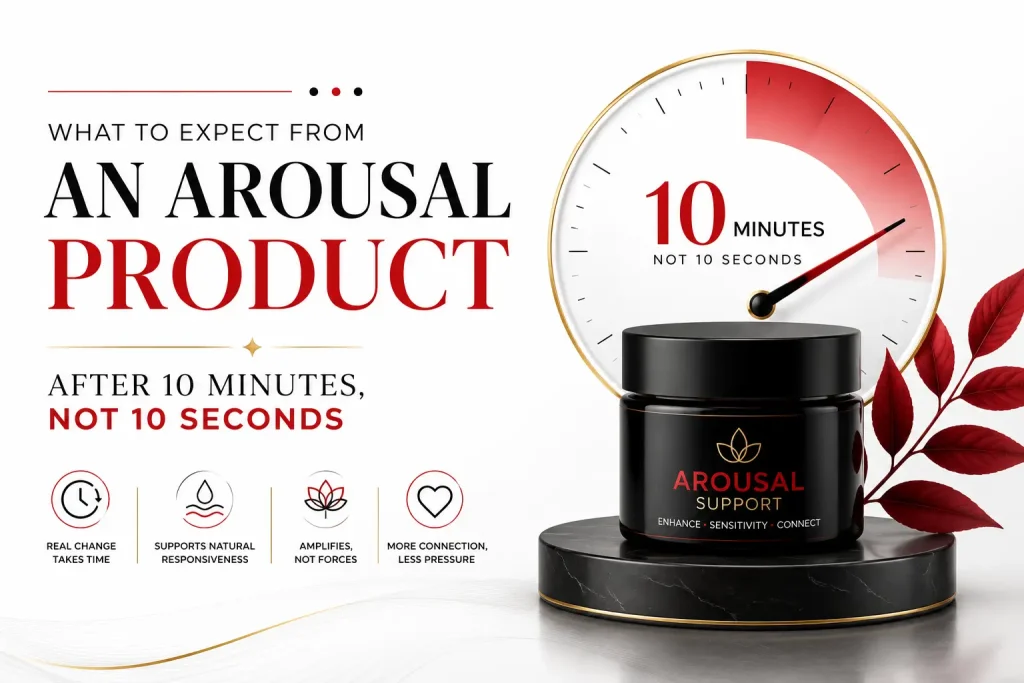
Many intimacy products promise instant results. The language is often urgent. Apply and feel something immediately. Tingling. Heat. Cooling. A rush. This framing has shaped expectations in a way that does not align with how arousal actually works, especially for women.
Real arousal is not a switch. It is a process. And meaningful changes in sensation rarely happen in seconds. They happen over minutes, sometimes longer. Understanding what should happen after ten minutes instead of ten seconds can completely change how people evaluate arousal products and how they experience intimacy.
Why instant sensation is not the same as arousal
Most products that advertise immediate effects rely on surface stimulation. Ingredients that create warming or cooling sensations trigger nerve endings in the skin. This can feel noticeable very quickly. But sensation alone is not arousal.
Arousal involves blood flow, nerve responsiveness, tissue sensitivity, and mental engagement. These systems do not activate instantly. They respond gradually as the body registers safety, attention, and stimulation.
When a product creates an immediate tingle, the body reacts to the ingredient, not to desire. The sensation may feel interesting at first, but it does not automatically translate into deeper responsiveness or pleasure. In some cases, it can even distract from arousal by overwhelming the nervous system.
What actually happens in the first few minutes
In the first two to three minutes after applying an arousal product, very little true change should be expected. The body is still adjusting. The skin is absorbing the formula. Nerve endings are registering contact. Blood flow has not yet meaningfully shifted.
If a product produces strong sensations during this window, that usually comes from topical irritants or temperature-based compounds. This is not inherently harmful, but it is not a reliable indicator of effectiveness.
During this early stage, the most important factor is comfort. There should be no burning, stinging, or discomfort. The body should feel neutral or gently aware, not rushed.
The five to ten minute window is where real change begins
Between five and ten minutes, a well-designed arousal product starts to show its true character. This is when increased sensitivity may begin to emerge. Touch may feel more noticeable. Pressure may register differently. Awareness may sharpen.
This shift happens because blood flow is increasing and nerve responsiveness is becoming more active. These are internal changes, not surface sensations. They feel subtle at first. Often they are described as a sense of openness, warmth from within, or heightened awareness rather than a specific feeling like heat or cold.
This is also the stage where the mind begins to engage more deeply. Physical readiness and mental readiness reinforce each other. When the body responds without discomfort, attention can move toward sensation instead of monitoring for irritation.
Why patience changes the outcome
Many people judge an arousal product too early. If nothing dramatic happens in the first thirty seconds, they assume it is not working. This leads to overapplication or switching products unnecessarily.
But arousal is cumulative. The body builds toward responsiveness. Giving a product ten minutes allows it to work with natural physiology instead of forcing a reaction.
This patience often results in a more authentic experience. Sensitivity develops gradually. Pleasure feels earned rather than imposed. The experience becomes easier to sustain instead of peaking quickly and disappearing.
The difference between activation and amplification
A common misconception is that arousal products are supposed to create desire. They do not. Desire originates in the brain and emotional context. What a good arousal product does is amplify what is already present.
After ten minutes, the body should feel more responsive to touch. Not necessarily more eager, but more capable of responding when desire is present. This distinction matters.
Products that try to activate desire through shock or sensation often fail to support sustained arousal. Products that focus on amplification allow desire to grow naturally without interference.
Signs a product is working properly
After ten minutes, effective arousal support usually shows up in subtle ways. Touch feels clearer. Sensations linger longer. The body responds with less effort. There is a sense of readiness rather than urgency.
There should be no numbness. No fading sensation. No distraction from the experience. Instead, the product should quietly support what is already happening.
Many users describe this as feeling more present in their body. That presence is a strong indicator of genuine arousal support.
Why strong sensations can backfire
Products that rely on intense warming or cooling often peak quickly. The sensation dominates the experience for a few minutes, then fades. When it fades, there is nothing underneath to sustain arousal.
In some cases, strong sensations can interrupt the natural arousal process. The body shifts into evaluation mode, monitoring the sensation instead of responding to touch. This can reduce pleasure rather than enhance it.
After ten minutes, these products often leave the body feeling neutral or slightly irritated, with no lasting benefit.
The role of formulation and intention
Not all arousal products are designed with the same goal. Some aim for immediate impact. Others aim for physiological support. Understanding this difference helps set realistic expectations.
Products designed for long-term arousal support often feel understated at first. Their value becomes clear over time, not instantly. They prioritize blood flow, nerve sensitivity, and comfort.
This approach aligns more closely with how arousal actually works. It respects the body instead of trying to override it.
What not to expect after ten minutes
Even with a high-quality product, arousal is not guaranteed. No product can create desire out of nothing. No formula can override stress, emotional disconnect, or lack of context.
After ten minutes, the expectation should not be a dramatic transformation. It should be a supportive shift. Increased responsiveness. Reduced friction. Greater ease.
When expectations are realistic, the experience improves. Disappointment fades. Curiosity replaces pressure.
Reframing success
If after ten minutes the body feels more receptive and the experience feels easier to sustain, the product is doing its job.
This reframing allows people to choose products based on compatibility rather than shock value. It also encourages a healthier relationship with intimacy itself.
Final thoughts
Arousal does not happen in seconds. It unfolds. Products that respect this process tend to deliver better results, even if they feel quieter at first.
By shifting focus from immediate sensation to gradual responsiveness, expectations align with reality. Ten minutes becomes a meaningful window. One where the body has time to respond, and pleasure has space to grow.
Understanding this difference can change not only how products are evaluated, but how intimacy itself is experienced.